


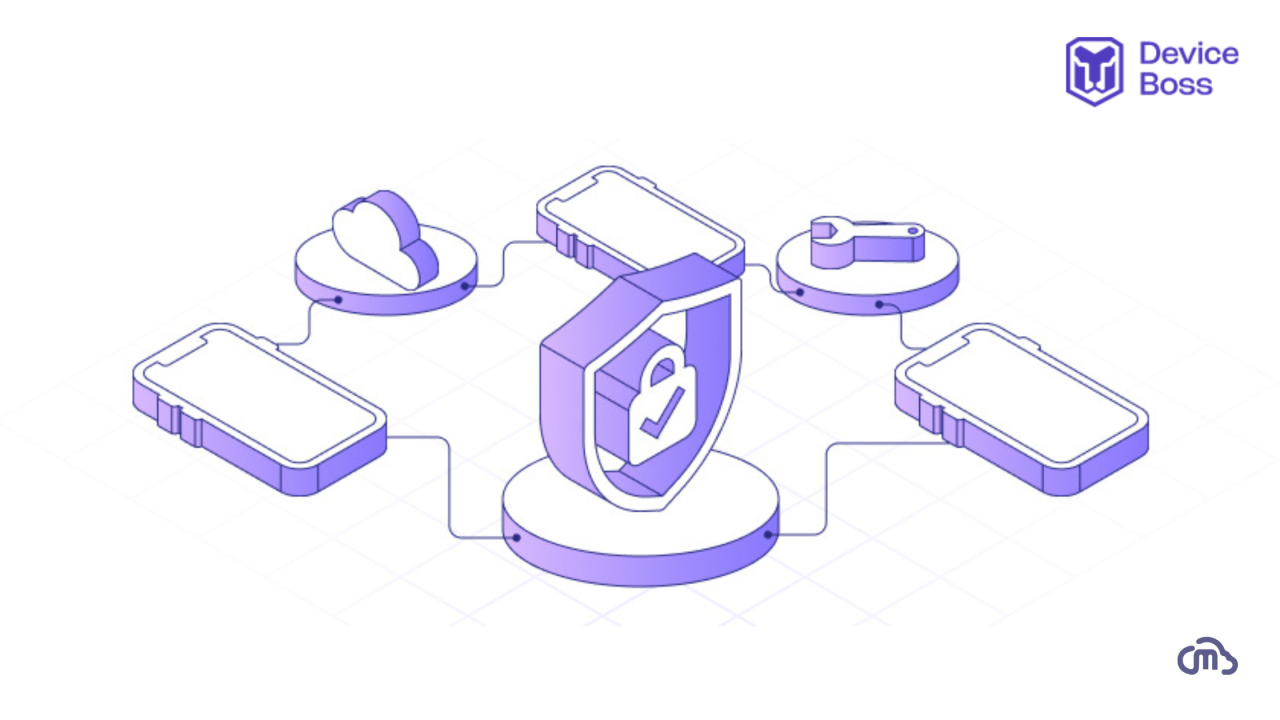
The modern workplace is more connected than ever. From laptops and smartphones to wearables, IoT sensors, and AR/VR headsets, every endpoint now plays a crucial role in enterprise operations. In 2025, Mobile Device Management (MDM) is not just about securing devices, it’s about empowering people, predicting risks, and simplifying control.
At Device Boss, we’re tracking how these evolving trends are redefining digital workplaces. Here are the top MDM trends shaping 2025, and how they’re transforming endpoint management for modern enterprises.
The digital ecosystem has expanded beyond traditional boundaries. Organizations today manage a mix of desktops, tablets, wearables, IoT endpoints, and AR/VR devices, each with unique configurations and risks.
In 2025, MDM platforms are evolving into universal endpoint management hubs, offering seamless control across all device types and operating systems. Whether it’s managing a VR training headset, an industrial IoT sensor, or a tablet in the field, MDM must now provide real-time visibility, configuration, and security across every connected asset.
Device Boss Insight: True endpoint management means one platform for every device-unified, automated, and adaptive.
Bring Your Own Device (BYOD) has become a strategic advantage, offering flexibility, cost savings, and productivity benefits. Yet, it also introduces new risks around data privacy and access control.
Modern MDM solutions now support granular separation of personal and corporate data, ensuring users enjoy device freedom without compromising enterprise security. Integration with identity and access management (IAM) frameworks adds another layer of protection, giving IT teams control over user authentication and data permissions.
In 2025, BYOD will thrive when businesses adopt policy-based controls - where security is enforced invisibly, and user privacy remains intact.
Cyber threats are becoming more unpredictable, targeting endpoints as the weakest link. MDM in 2025 is evolving with proactive, AI-enhanced security measures.
Expect features like device encryption, biometric authentication, real-time anomaly detection, and mobile threat defense (MTD) integration to become standard. Machine learning helps MDM platforms identify unusual patterns, quarantine compromised devices, and predict vulnerabilities before they’re exploited.
Security is shifting from reactive defense to predictive intelligence, where prevention is built into every layer of device management.
The era of implicit trust is over. The Zero Trust model “never trust, always verify” is now at the heart of modern device management.
MDM platforms are integrating Zero Trust principles to enforce continuous verification of users and devices. Even after a device is authenticated, it undergoes ongoing checks for compliance, location, and behavior to ensure it remains trustworthy.
Zero Trust = Zero Breach. Continuous authentication ensures even compromised devices can’t silently endanger the network.
As businesses expand globally and embrace hybrid work, cloud-based MDM is becoming the backbone of enterprise mobility.
Cloud MDM offers scalability, centralized visibility, and real-time updates without the complexity of on-premise infrastructure. IT administrators can manage thousands of endpoints across regions , enforcing policies, deploying updates, and monitoring compliance from a single pane of glass.
Device Boss Takeaway: Cloud-driven MDM delivers agility, it’s built for remote work, global teams, and rapid scaling without security trade-offs.
In 2025, MDM success isn’t measured just by control but by user experience. Modern platforms are designed to be intuitive, transparent, and employee-friendly, offering self-service options, simplified enrollment, and unobtrusive security enforcement.
When employees find MDM tools easy to use, adoption rates and overall security posture, improve dramatically.
The future of MDM is people-first- security that empowers, not restricts.
Automation is now the heartbeat of MDM. From auto-enrollment and self-healing devices to predictive analytics and automated policy enforcement, AI is revolutionizing how IT teams manage device ecosystems.
By analyzing usage data, compliance trends, and security events, AI-driven MDM platforms can generate actionable insights, helping IT teams fix issues before users even notice them.
AI turns MDM into a living system , one that learns, adapts, and evolves with every connected device.
As global data protection laws tighten, compliance has become a cornerstone of MDM strategy.
In 2025, MDM platforms must align with evolving frameworks like GDPR, HIPAA, and ISO 27001, offering tools for encryption, audit trails, and compliance reporting.
Strong privacy controls ensure personal data is isolated, encrypted, and handled transparently, building trust with both regulators and end users.
Device Boss Note: Compliance isn’t just about regulations, it’s about earning user trust through transparent and ethical data practices.
As digital transformation accelerates, MDM is evolving from a control tool to a strategic enabler. The MDM of 2025 is intelligent, cloud-powered, AI-driven, and people-centric, ensuring businesses can innovate securely and operate confidently across every device, anywhere in the world.
At Device Boss, we believe the next wave of device management will be defined by trust, intelligence, and simplicity empowering organizations to stay connected, compliant, and secure in an increasingly mobile world.