The Most Overlooked Moment in Digital Transformation? When Someone Picks Up a Device. Hirudo Android banking & Stryker attack relevance
What a factory shift and a banking field visit reveal about the gap between deploying technology and making it work.
At 6:55 a.m., a production operator picks up a shared tablet before the morning shift.
The work instructions should be ready. Instead, an application needs updating, the network settings have changed, and nobody is sure whether the spare tablet was charged overnight.
A few hours later, a field agent working for a financial services company arrives for a customer onboarding appointment.
The setting is different, but the problem feels familiar. The device does not have the expected application version. The agent cannot resolve it independently, and the customer is waiting.
These are illustrative scenarios, but they raise the same question:
What happens when an organization digitizes the workflow without giving equal attention to the device that carries it?
Manufacturing: When the Device-Management System Becomes the Target
A production operator picks up a tablet and finds it unusable. Now imagine that problem unfolding across an organization—not because the devices failed, but because someone gained control of the system managing them.
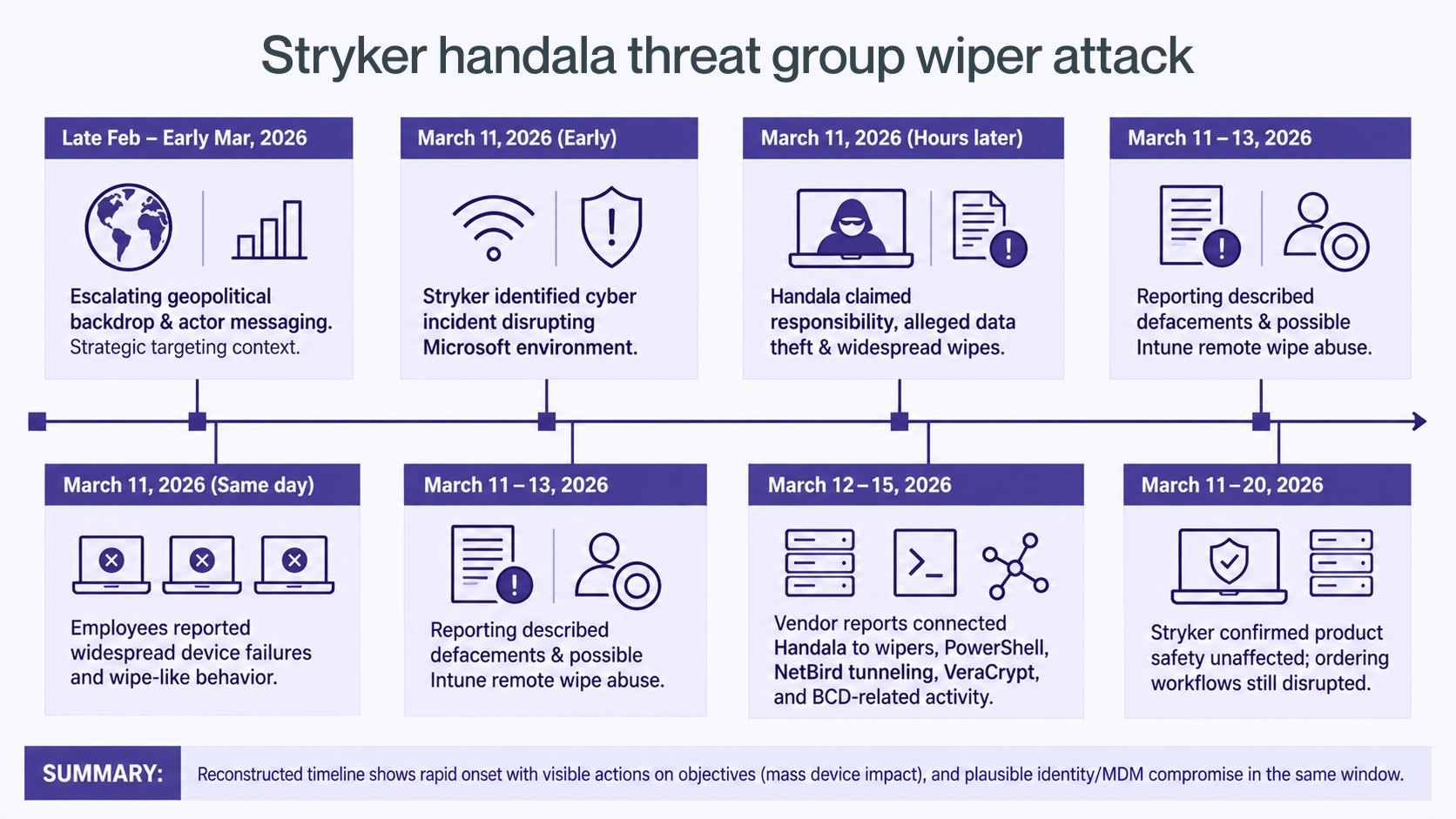
That is what makes the March 11, 2026 attack on medical-device manufacturer Stryker particularly relevant. According to BlackBerry’s account, attackers obtained privileged administrative access and used the company’s Microsoft Intune environment to issue remote-wipe and factory-reset commands. The incident disrupted manufacturing, ordering and internal communications. It involved the misuse of legitimate management capabilities rather than a conventional ransomware deployment. The lesson is not that centralized device management is the wrong approach. It is that the management platform itself must be treated as critical infrastructure.
The same console that helps IT configure devices and protect business data can cause widespread disruption if administrative access falls into the wrong hands. BlackBerry’s analysis highlights least-privilege access, phishing-resistant multifactor authentication, monitoring of administrative activity and additional validation for high-impact actions as important safeguards.
For manufacturing leaders, this changes the buying conversation. “Can we manage every device centrally?” remains important. But it needs a second question: “How carefully do we protect and govern that central control?”
Financial Services: When a Familiar Banking App Is No Longer Trustworthy
For a financial-services field agent, an application update can look like an ordinary part of the working day.
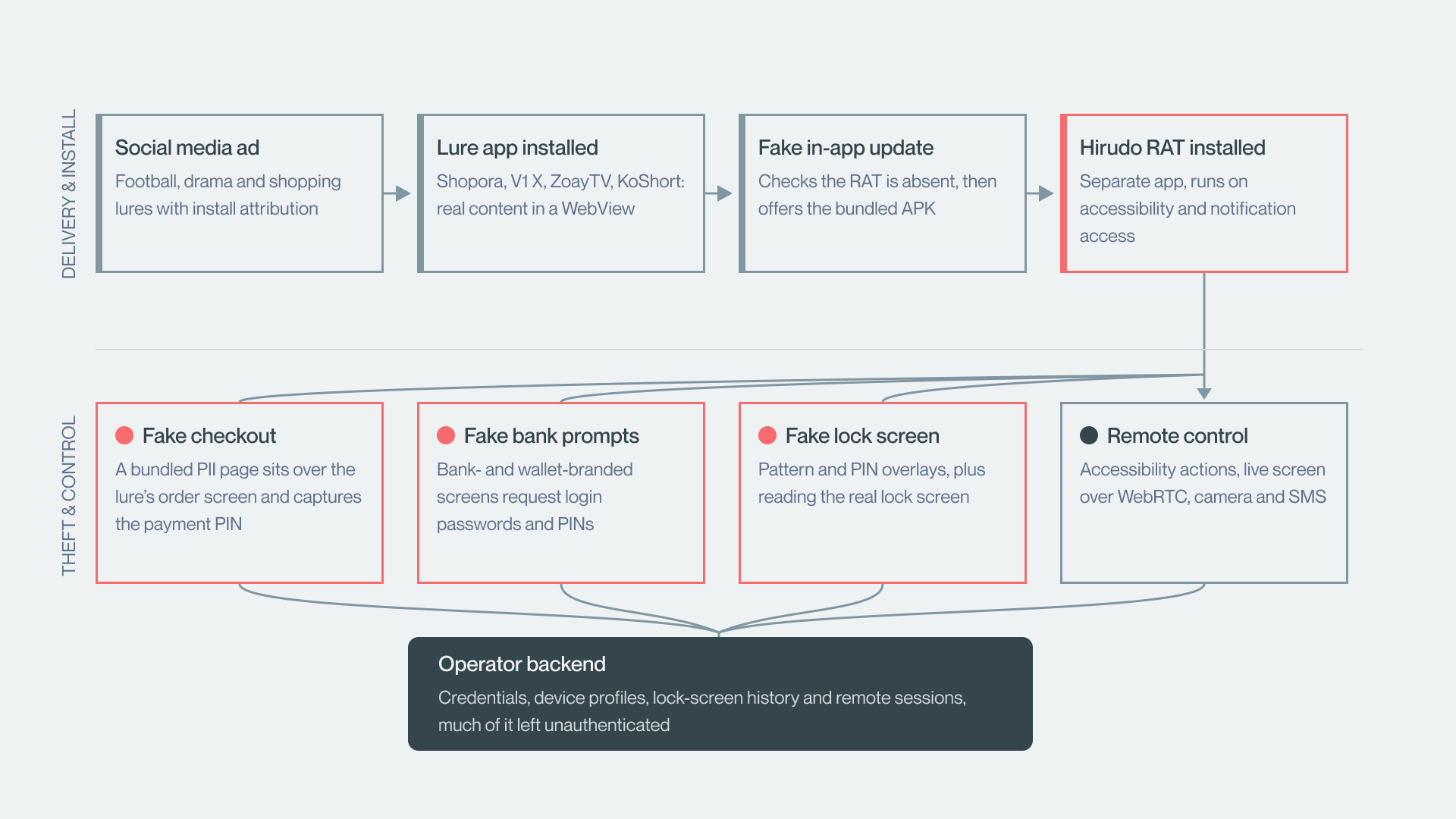
That familiar interaction is what makes the Hirudo Android banking trojan relevant. In an October 16, 2026 briefing, Ankura and an October 14, 2026 Hacker News report described research showing that Hirudo uses deceptive applications and update prompts to persuade users to install malware and grant Accessibility permissions.
It can then replace legitimate banking applications with modified versions designed to steal financial information and bypass security checks. Its primary targets were eight Indonesian banking applications.
The threat goes beyond a fake login screen. Reported capabilities include credential and SMS theft, remote device control and screen streaming. The total number of victims remained unknown in the briefing.
For organizations managing company-owned Android devices, this creates a direct device-governance question: should an employee be able to install an application from an unapproved source or replace a business-critical app outside the authorized deployment process?
App allowlisting, installation restrictions and centrally managed application deployment are relevant controls to evaluate against those pathways. They should not, however, be presented as a guarantee against Hirudo. The research also points to the need for server-side integrity verification, behavioural analytics and transaction-risk monitoring.
The management lesson is straightforward: a familiar icon on a screen is not enough to establish that an application can be trusted.
The Connection: Manage the Device and Protect the Management Layer
These examples reveal two sides of the same challenge.
At Stryker, attackers reportedly abused trusted administrative control. In the Hirudo campaign, attackers manipulated the applications and permissions on the device itself. One highlights the need to secure the management layer; the other highlights the need to govern what can run on managed endpoints.
That is the context in which mobile-native MDM platforms such as Device Boss MDM should enter the discussion—not as a promise to prevent every attack, but as part of a broader approach to governance.
For a manufacturer, that means supporting dependable devices without leaving administrative power insufficiently protected. For a financial-services organization, it means enabling mobile work without making application installation and configuration an uncontrolled process.
The objective is not simply more control. It is the right control, protected appropriately, so employees can get on with the work the device was intended to support.
Different Industries, the Same Overlooked Handover
A factory tablet may pass between three operators in a day. A financial-services device may pass from one agent to another after a regional transfer.
Both transitions raise practical questions:
● Does the device have the applications required for its next assignment?
● Are the settings appropriate for the role?
● Does previous access need to be removed?
● Can administrators see whether the device is online and ready?
● What happens if it is lost or sent for repair?
These are not dramatic cybersecurity questions. They are routine management questions. Yet routine gaps deserve attention precisely because they can persist unnoticed.
The financial-sector report makes a similar point at a broader level: breaches are rarely a single lapse; they can develop through a chain of compounding weaknesses. It calls for continuous risk assessment rather than relying only on periodic security interventions.
Consistency Without Unnecessary Friction
The answer is not to apply the strictest possible restriction to every device.
A dedicated production terminal may need only one application. A supervisor may need several approved tools. A field agent needs a configuration that supports mobility rather than treating it as an exception.
What matters is consistency within the intended role.
This is where the device-management layer—including platforms such as Device Boss MDM—belongs in the conversation. Its purpose is not to become another task for the employee. It is to bring structure to enrollment, application access, configuration, monitoring and device transitions behind the scenes.
MDM should sit alongside identity security, threat detection, employee awareness and incident response—not be mistaken for a replacement for them.
The Last Mile of a Digital Strategy
Digital transformation is usually discussed through major investments: manufacturing execution systems, customer onboarding platforms, enterprise applications and automation. The device at the edge of that strategy receives less attention—until it becomes the reason work cannot move forward.
On a factory floor, a tablet connects an operator to work instructions, production records or quality checks. In banking and financial services, a mobile device connects a field agent to customer onboarding, document collection or service applications.
In both environments, the application may be central to the business. But its usefulness depends on something more ordinary: whether the person holding the device can use it securely and reliably at that moment.
That is where digital strategy meets daily execution.
Standardize the Foundation, Not Every Employee’s Experience
There is a temptation to equate stronger management with tighter restrictions everywhere. But a useful device policy starts with the task.
A factory terminal dedicated to production logging may suit single-app kiosk mode. A supervisor may need several approved applications. A field agent may require a different configuration from a branch-based employee. The goal is not to make every device behave identically. It is to make each device behave predictably for its intended role.
This is where mobile device management becomes more than a security control. Group-based policies, approved-app access, remote deployment and device-status visibility can bring structure to the relationship between a person, a device and a job.
Device Boss MDM fits into that management layer, helping organizations configure and manage devices centrally while applying different policies to different operational groups.
Its role is most meaningful when management becomes less visible to the employee, not when the employee has to think about it more.
Look Beyond Deployment Day
A successful rollout is only the beginning. The harder test comes later: when a tablet moves from assembly to packaging, an agent transfers to another region, or a damaged device is handed to a repair vendor.
Each transition raises a practical question. Should the applications change? Should access be removed? Does business data need to be wiped? Who confirms that the device is ready for its next assignment?
Thinking in terms of a device lifecycle, rather than a one-time deployment, brings these moments into the original plan.
It also changes the conversation between IT and business teams. Instead of asking only, “How many devices have we enrolled?” they can ask, “How reliably are those devices supporting the work?”
A Better Measure of Progress
Return to the operator starting a shift and the agent meeting a customer. Neither needs to see the management console behind the device. Neither needs to understand how a policy was assigned or an application deployed. They need a tool that is ready for the task and a clear support path when it is not.
For leaders across manufacturing and financial services, that is a useful way to evaluate digital progress. Not only by the sophistication of the platform, but by the quality of the everyday experience it enables.Sometimes, the next step in digital transformation is not adding another layer of technology.
It is making sure the technology already in someone’s hands does not get in the way.